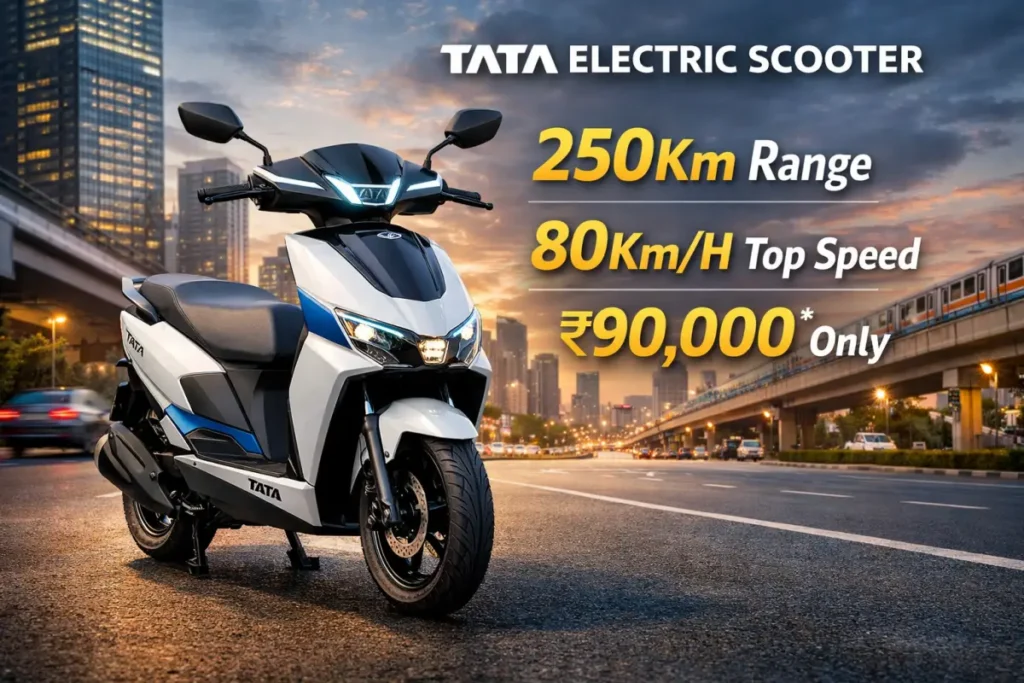
India’s electric two-wheeler space is moving fast. Petrol prices remain high, city traffic keeps growing, and buyers now care more about daily running costs than badge value. In this situation, news of a new electric scooter from Tata Motors has created serious interest. The reason is simple. The claimed range, speed, and price combination looks almost unreal on paper. A 250Km riding range, 80Km/H top speed, and a price near ₹90,000 put this scooter in a space no current rival fully covers.
This article breaks down what this new Tata electric scooter offers, how realistic the claims are, who should consider it, and what it could mean for India’s EV market. Everything is explained in simple language, without hype, and with daily use in mind.
Why Tata’s Entry Into Electric Scooters Matters
Tata is not new to electric vehicles. The company already sells popular electric cars used by families, taxi fleets, and city commuters. Until now, Tata stayed away from electric scooters. That gap is important because two-wheelers make up most vehicle sales in India.
A Tata electric scooter brings trust into a market where buyers still worry about battery life, service quality, and resale value. Many people like EVs but hesitate because smaller brands may not last long. Tata’s name reduces that fear.
For first-time EV buyers, brand trust matters as much as features. This is where Tata gains an edge before the scooter even hits the road.
Read also: Toyota Century 2026 Launched: Flagship Luxury Sedan at Half the Cost of Rolls-Royce
Claimed Range: What 250Km Really Means
The headline feature is the claimed 250Km range. That number instantly grabs attention. Most electric scooters today offer real-world ranges between 90Km and 160Km.
A 250Km claim usually means testing under light load, steady speed, and perfect road conditions. In daily city riding, range drops. Traffic, quick acceleration, road bumps, and rider weight all affect battery use.
Still, even if real world range settles near 180Km to 200Km, it remains very strong. That means many users may charge only twice a week. Office commuters can ride several days without plugging in.
For delivery riders and shared mobility use, longer range cuts charging breaks. Less downtime means more daily income.
Battery and Charging Expectations
While official battery size details are limited, a 250Km range suggests a large capacity lithium-ion pack. Tata has experience with battery packs through its car division, which helps with safety and thermal control.
Charging time matters as much as range. Based on similar setups, normal home charging may take six to seven hours. Fast charging support is expected, though final details will confirm this.
For most users, overnight charging at home is enough. Plug it in after dinner, unplug it in the morning. No fuel stops, no queue, no smell.
Battery life also matters. Buyers expect at least five to seven years of usable life. Tata’s track record suggests focus on durability over flashy claims.
Read also: Tata Nano EV 2026 Launched With 550km Range, 150kWh Battery at ₹2.99 Lakh
Top Speed and City Riding Comfort
The scooter claims a top speed of 80Km/H. This is more than enough for Indian roads. City traffic rarely allows speeds above 60Km/H for long.
An 80Km/H top speed means smooth cruising at 50 to 60Km/H without strain. The motor will not feel stressed during daily use. That helps with long-term reliability.
For short highway stretches or flyovers, this speed keeps the rider confident. It avoids the slow feeling that many low-powered electric scooters suffer from.
Acceleration is also key. Electric scooters usually deliver quick pickup from zero speed. This helps in traffic gaps, signals, and tight turns.
Read also: Patanjali Electric Cycle 2026 Launched: 320KM Range, Budget Price, and Smart Features
Design Approach: Practical Over Flashy
Early visuals suggest Tata has kept the design clean and functional. This scooter does not try to look aggressive or sporty. It looks like a daily tool, not a showpiece.
Flat footboard space, wide seat, and upright riding posture suit family use. This matters for Indian buyers who carry bags, groceries, or even kids.
Storage under the seat is expected to handle helmets and small items. External hooks and glove boxes may be included for added ease.
The focus seems to be comfort, balance, and ease of use rather than sharp styling lines.
Read also: KTM Electric Bicycle 2026 Review: Price, 450KM Long Range, Lightweight Frame, and Smart Features
Features That Matter to Daily Users
Instead of chasing fancy screens or complex menus, Tata is likely to focus on features that help with daily riding.
Here is a simple table summarising the expected features and pricing.
| Feature | Details |
| Claimed Range | Up to 250Km per charge |
| Top Speed | 80Km/H |
| Battery Type | Lithium-ion |
| Charging | Home charging with fast charge support |
| Display | Digital instrument cluster |
| Riding Modes | Eco and Normal |
| Braking | Disc brakes with combined braking |
| Connectivity | App support for basic stats |
| Expected Price | Around ₹90,000 (ex-showroom) |
These features cover what most riders actually use. Speed readout, range estimate, battery status, and trip data are enough for daily needs.
Price Positioning and Market Impact
The expected price of ₹90,000 places this scooter in a very interesting position. Many current electric scooters with a lower range already cost close to or above this price.
If Tata manages to launch near this figure, it will put pressure on rivals. Buyers may delay purchases, waiting for Tata’s offering. Some brands may need to revise prices or add features.
Government subsidies can further reduce the on-road cost in some states. This makes the scooter even more attractive to first-time buyers.
For petrol scooter owners, the math becomes simple. Lower running costs, less maintenance, and no fuel price worries.
Read also: Yamaha Rajdoot 350 2026 Bike: Old-School Design Meets Modern Features
Maintenance and Service Support
Electric scooters need less maintenance than petrol ones. No oil changes, no spark plugs, no engine noise issues.
Tata’s service network is one of the largest in India. If the company integrates scooter service into existing centres or dedicated EV outlets, ownership becomes easier.
Spare parts availability and trained staff make a big difference over time. Many EV buyers worry about repairs after the warranty. Tata’s scale helps reduce that fear.
Software updates, battery health checks, and motor diagnostics can be handled through regular service visits.
Who Should Consider This Scooter
This scooter fits several user types.
Office commuters who ride daily in cities will value the long range and low running cost. Charging once or twice a week feels easy.
College students looking for a modern, quiet ride without fuel expenses may find it appealing. Parents may trust the Tata name more.
Delivery riders and gig workers benefit from fewer charging stops and stable performance throughout the day.
Families needing a second vehicle for errands, school runs, and short trips will find this scooter practical and easy to ride.
Real World Challenges to Watch
Every new model faces challenges. Battery performance in extreme heat is one area to watch. Indian summers test EV systems hard.
Charging access in apartments remains an issue for some users. Tata may need to work with housing societies to support shared charging points.
Waiting periods can also rise if demand spikes. Early buyers should expect some delay after launch.
Final specifications, warranty terms, and service costs will decide long term satisfaction.
How This Scooter Changes Buyer Expectations
A claimed 250Km range changes what buyers expect from electric scooters. People may stop accepting short-range as normal.
If Tata delivers close to its claims, other brands will need to catch up. This pushes the whole market forward.
More competition leads to better products and fair pricing. In the long run, riders win.
Final Thoughts
The new Tata electric scooter shows how fast India’s EV space is maturing. Strong range, usable speed, and sensible pricing address real problems faced by riders.
This is not about hype or luxury. It is about daily use, savings, and peace of mind. If Tata matches its promises with solid delivery, this scooter could become a common sight on Indian roads.
For buyers waiting on the sidelines, this launch may be the push they needed. Electric mobility no longer feels like a compromise. It feels ready.